![]() |
Mission Monthly |
...Meditate on These Things.
Phillipians 4.8 "The outer signs are only to remind us of inner things."St. Elizabeth the New Martyr
It is very rare to hear anyone (even the non-believer) complain or criticize
the outward “religious” beauty and splendor of Orthodox Christianity.
On those rare occasions when criticisms are heard they can usually be
quelled by gentle conviction and sincere explanation.
What are some of these criticisms? One
eventual convert to the Orthodox Church summed it up this way, “When I first
encountered Orthodoxy I believed the Church to be more concerned about its
‘smells and bells’ than a deep and abiding relationship with Jesus
Christ.”
Prior to her
marriage to the Grand Duke Serge Romanov, Princess Elizabeth of Hesse was raised
and lived devoutly as a Protestant Christian.
Unlike her sister Alice (who would become the Tsarina Alexandra),
Elizabeth was not “required” to join the Orthodox Church prior to her
marriage to the Grand Duke. After
her marriage she would remain Protestant for seven years.
Initially,
like anyone unfamiliar with the traditions of Orthodoxy, Elizabeth struggled to
understand the meaning behind Orthodoxy’s outward piety and customs.
Nevertheless, out of her own love for God, respect for the Church and
love for her husband she reverently followed her husband and the practices of
the Orthodox Church. Like many converts of our own day Elizabeth had to learn how
to cross herself, how to make a metania (low bow) before an icon and how to
venerate (kiss) an icon or the hand of the priest. In a letter to her Grandmother, Queen Victoria of England,
Elizabeth wrote, “Of course there were holy pictures, but when Serge knelt and
kissed them I made a low curtsy; in that way it does not shock the people so
much, and yet I think that I do not go too far. I only kiss the cross when held out to me and as it is the
custom to kiss the priest’s hand… I do it too – it is a mark of
politeness.”
Eventually
Elizabeth would indeed come to her own convictions about the Orthodox Faith
(without any pressure from her husband I will add).
She would continue to attend Protestant services and have long talks with
her pastor, but over time (even from the beginning of her marriage) she became
more and more attracted to the Orthodox Faith. Eventually she would discover that Protestantism could no
longer satisfy her spiritual quest as she longed year after year to enter into
the joy she witnessed in those preparing for and entering fully into the
celebration of the Divine Services, of Holy Communion, of Holy Pascha.
Eventually she would have to tell her father and her family that she
would be leaving their church to join the church of her husband; and like many
in our own day, it was not easy. When
the time came and Elizabeth could no longer keep inside her desire to become
Orthodox she communicated with her father, brother and sisters but none
understood the step she was taking. Her
brother Ernest even accused her of being “charmed” by the “outer
brilliance” of Orthodoxy. Elizabeth simply replied, “Nothing in the outer signs
attracted me… [rather] the foundation of the belief.”
St.
Elizabeth was very intelligent, wise, thoughtful, and prayerful.
She was a woman of consideration and deep conviction.
She was deeply loved for her piety and her service to the poor and needy.
No one could have ever accused her of being flighty or subject to the
winds of inferior influence. Behind
every action she took, belief she accepted or word she spoke was a singular
desire to please God. I do not
believe that she would have ever been attracted to Orthodoxy because of its
“charming” exterior; others might be but not Elizabeth.
It is with this in mind that we contemplate the above quote and how truly
important it is for us to seek understanding and acceptance of the reasons why
the Orthodox Church looks the way it does; from architecture to iconography,
from Liturgy to personal prayer; from piety to celebration, from Doctrine to
Tradition.
Judeo-Christian
history is a history rich with symbolism. From
Adam to Noah to Abraham to Moses to David to Jesus to the Church today there has
been established many, many symbols which not only represent or express an idea
but more importantly reveal a Truth. As
Orthodox Christians and recipients of the fullness of this holy lineage we must
seek to accept this with all our hearts. The
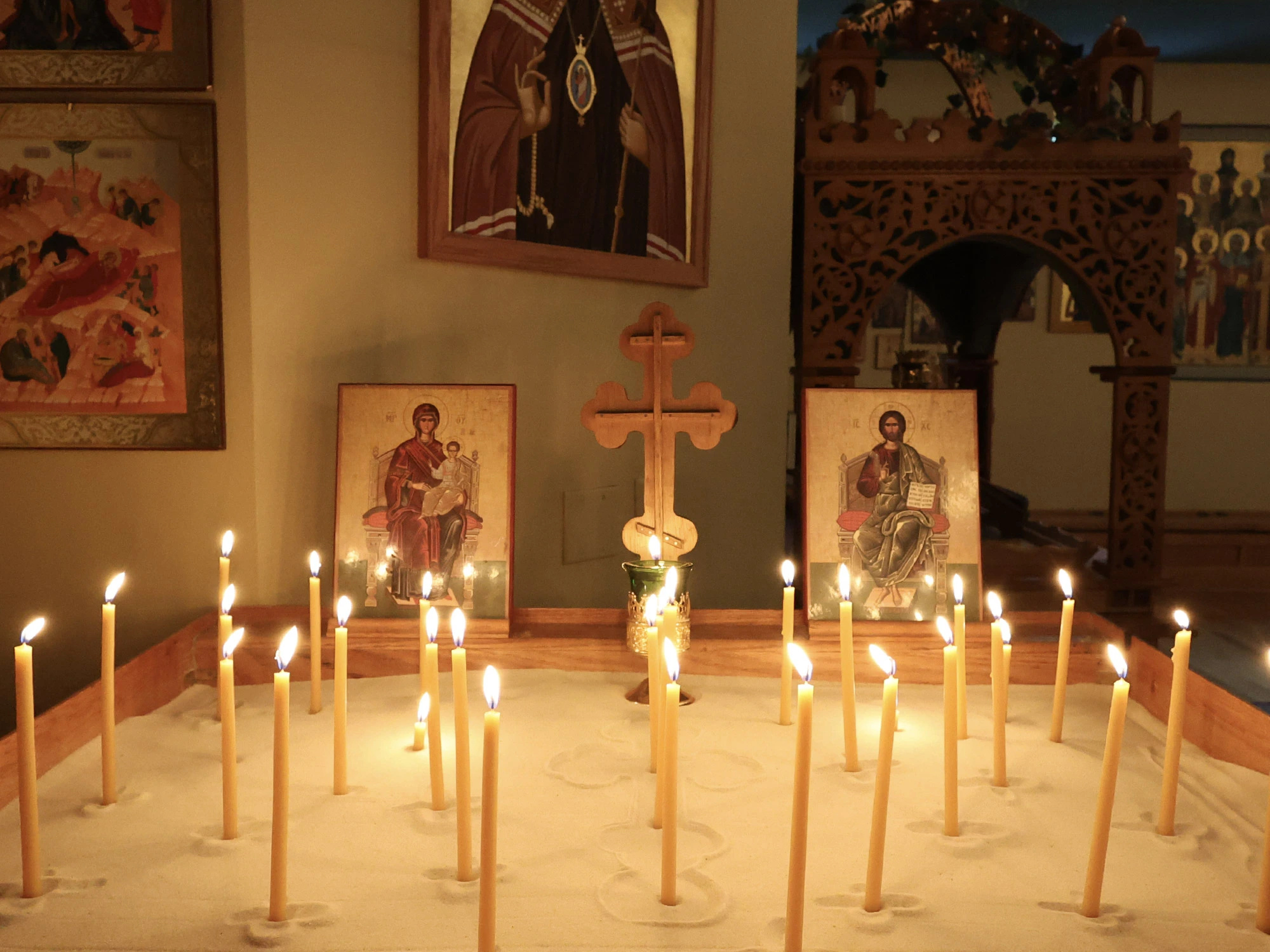
icons that adorn our churches and homes are more than just pictures.
The vestments our priests wear are more than just clothes.
The crosses that we wear are more than just jewelry. The incense that we offer is more than just smoke.
The Divine Services that we pray are more than just words.
The hymns that we sing are more than just songs.
The churches that we worship in are more than just buildings. And the lives we have been given by God are more than just
flesh and blood. It is necessary
for us to become expressions of these inner mysteries lest we fall into the trap
of “holding the form of religion but denying the power of it” (2 Tim. 3:5).
St. Elizabeth was challenged about this when she decided to become
Orthodox. She knew, however, that
the life of the Orthodox Christian Church is rich in Spirit and meaning.
By God’s grace she did learn it; so deeply in fact -
she died for it.
![[HOME]](home.gif)