![]() |
Mission Monthly |
...Meditate on These Things.
Phillipians 4.8"My desire to paint [write]
icons coincided with my seeing in the church an artistic expression whose
content visually brought to life what I prayed, believed in, and strove for all
my life"
Iconographer John Lickwar
The WORD Magazine - June, 1999
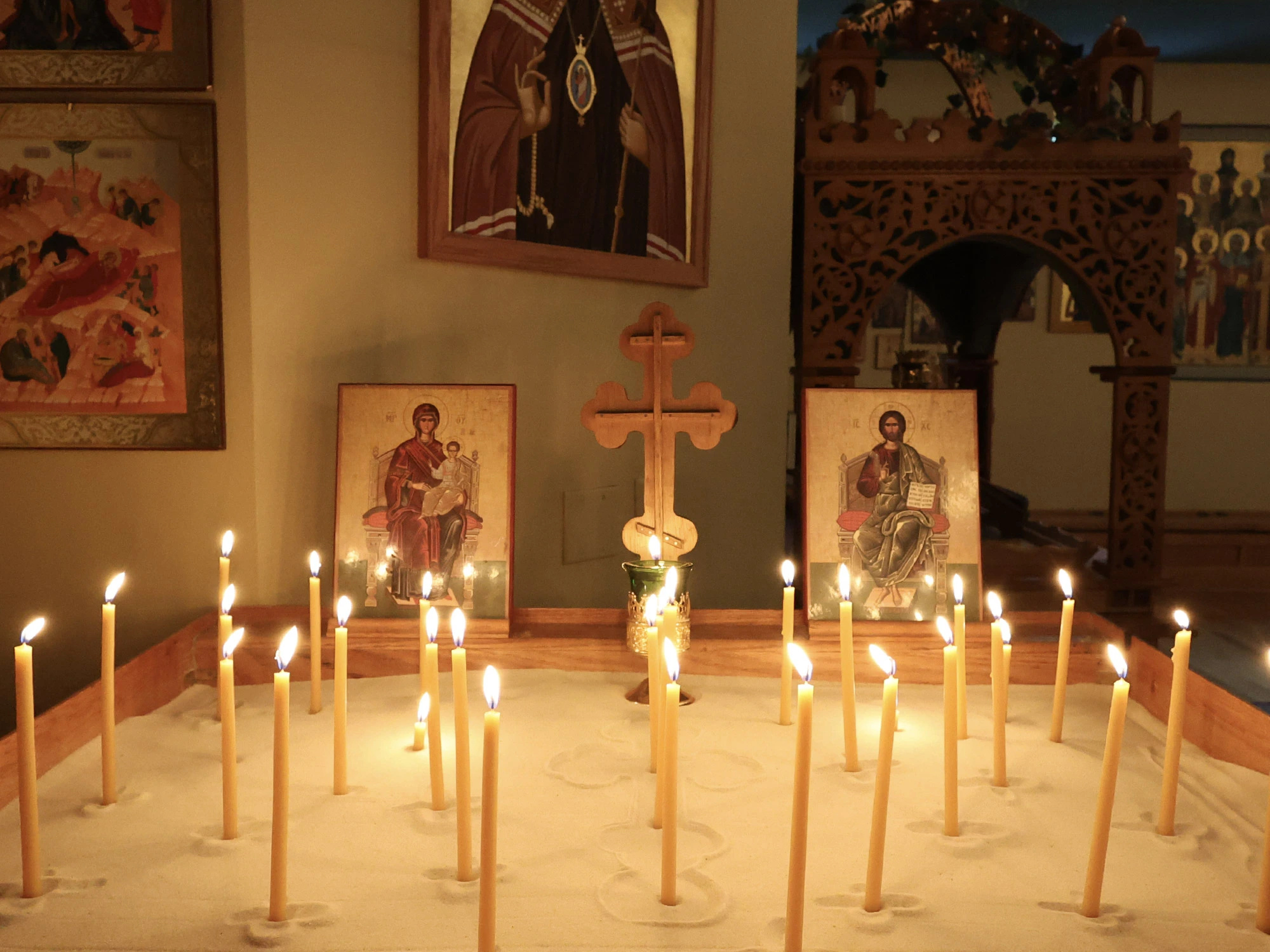
One of the most impressive and beautiful aspects of the Orthodox Church
has to be her “art” forms. The
two most obvious are liturgical music and iconography.
One cannot pray as an Orthodox, either privately or corporately, without
the images and sounds of the Church always before him.
Observers of the Orthodox Church, often without full understanding, are
continually awed by the majesty expressed in the sights and sounds of Orthodoxy.
It is a delicate matter, however, to discuss icons and hymnography.
Whether one is a member of or visitor to the Orthodox Church, tradition
and taste always arouse a variety of responses to the questions surrounding
these expressions of faith; Orthodox Christians may have a strong preference for
either Byzantine or Slavonic stylings, while Christians from other traditions
may have a wide range of appreciation/non-appreciation, attraction/disdain or
acceptance/rejection. What I’ve
gathered from discussions with Christians from non-Orthodox backgrounds is that
these forms are “foreign” and “exotic” and take much effort to become
accustomed to, which the Orthodox take for granted.
From the Orthodox perspective any suspicions regarding the use of icons
(whether Christological or pagan) were settled long ago.
According to the 7th Ecumenical Council (Nicea, +787) and the debates of
the 8th and 9th centuries, the icon of Christ affirms a confession of faith in
the Incarnation. Art cannot retain
a “neutral” function, it can and even must express faith.
Icons are an expression and source of divine knowledge proclaiming the
good news about God becoming man, about deified humanity, first in Christ, but
also through Him and the Holy Spirit in the Virgin Mary and all the saints.
“Thus, it was the council’s decision that the rejection of the holy
images was the rejection of the fact of salvation by God in Christ and the Holy
Spirit” (The Orthodox Faith, v. 3, Bible
and Church History, Fr. Thomas Hopko).
The council also clarified the subtle, yet very clear distinction between
veneration and worship. In the
fullness of the Incarnation Christ alone can be depicted in icons, not God the
Father or the Holy Spirit. The icon
itself is honored because it is both representation and reality.
It is an object of veneration while worship is reserved for God alone.
The Theotokos and the saints are depicted and venerated, never
worshipped, because of the image of Christ revealed through their faithful and
holy lives. “It
is no longer I who live, but Christ who lives in me...” (Gal. 2:20).
The kissing of or bowing before an icon is a pious action addressing its
“prototype” as a simple sign of worship to God and adoration of His saints.
I meditate on this topic because of the sincere struggles I’ve
encountered with inquirers who desire to embrace all that is Orthodox.
Also, I never want to take for granted the beautiful understanding and
appreciation I’ve been given for all the expressions of faith in the Church. What is seen in the images and heard in the hymns enlightens
the pathway of our salvation like a series of clues leading to the solving of a
great mystery. Indeed, God’s
mystery is revealed in the sights and sounds of His Church, bringing to life
that which we believe and pray!
![[HOME]](home.gif)